
Microsoft 365 Copilot for Civil Engineering Firms (2026)
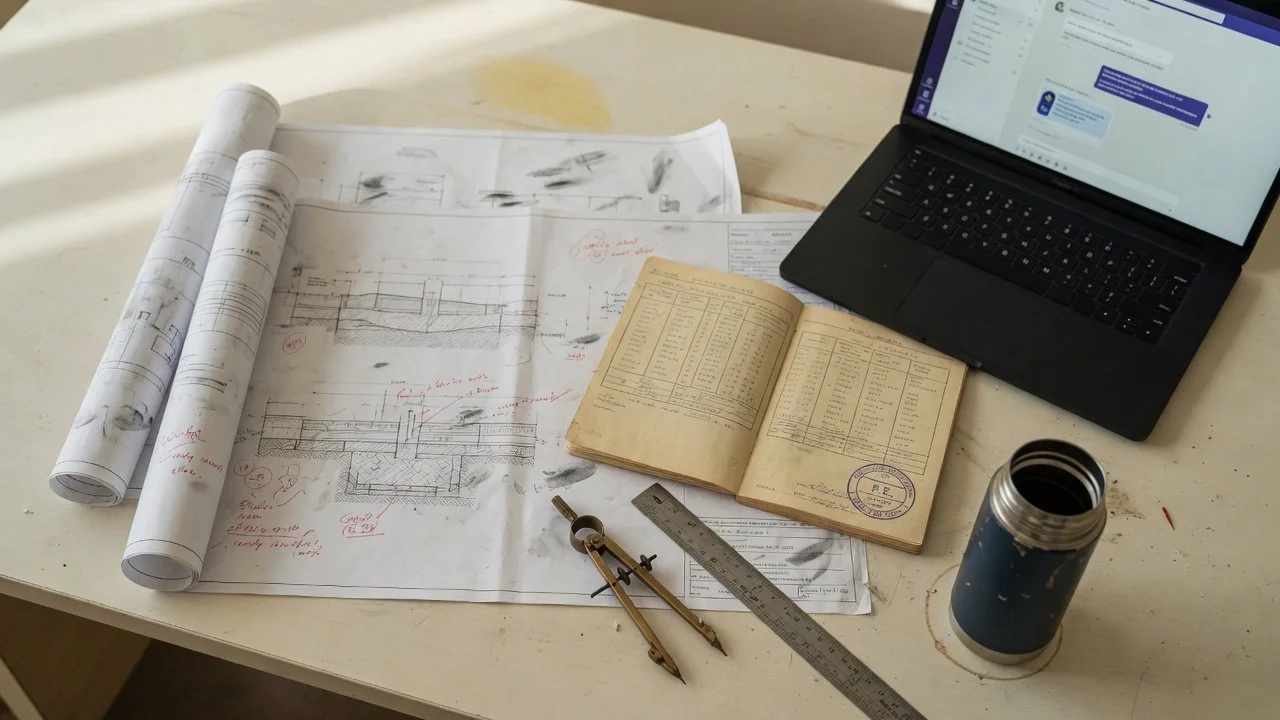
AI Document Search • Microsoft Copilot • May 2026
At a 60-engineer civil firm in the Pacific Northwest, the IT director turned on Microsoft 365 Copilot Enterprise firmwide in March. The bill: $30 per user per month on top of E5, roughly $21,600 a year in license fees alone. Six weeks later, a senior PE asked her junior to redraw a 2014 abutment detail because Copilot couldn't find the original. The 2014 file was a scanned PDF on the firm's network drive, invisible to Microsoft Graph, the indexing layer Copilot relies on.
Copilot is genuinely good at what Microsoft built it to be: email triage in Outlook, meeting summaries in Teams, Excel formulas, Word drafting. For most civil engineering firms with M365 already deployed, Copilot is the default "we already have AI" answer when someone asks about document search. That answer is right for some questions and wrong for others. This article is about which is which.
Below: what Copilot does well, where it breaks on a civil engineering archive, what to deploy alongside it for the queries it can't serve, and the math for a 60-engineer firm running both. References to Microsoft Copilot pricing are from Microsoft's published pages; SalemWise pricing is published below.
Why Microsoft Copilot Falls Short for Civil Engineering Archive Search
Copilot is a strong general-productivity assistant. Microsoft's commissioned Forrester study reports measurable ROI on email, document drafting, and meeting workflows. None of that translates to engineering archive retrieval, because Copilot was not designed for it. Three structural reasons compound on each other for civil firms.
1. It indexes Microsoft 365, not your archive
Microsoft Graph indexes content already in SharePoint Online, OneDrive, Exchange, and Teams. A civil firm's archive, the part that holds 30 years of institutional value, lives in a mix of SharePoint, shared network drives, ProjectWise, and external hard drives. Microsoft publishes more than 100 Copilot connectors covering Confluence, Salesforce, ServiceNow, Jira, and Google Drive. ProjectWise is not on that list. Neither is any civil-engineering vertical connector.
2. It does not OCR legacy scans
Copilot grounds answers against text Microsoft Graph has indexed. A 1996 plan set scanned at 200 dpi with bleed-through on the back of the sheet is an image to Graph. There is no engineering-grade OCR pipeline behind Copilot, no layout detection for title blocks, no multi-pass low-confidence rejection, no tuning for stamped dimensions or callouts. The geotechnical bore log on your file server from 2008 stays unsearchable even after Copilot is firmwide.
3. Citations are not page-level
Copilot links back to source documents, but not reliably to the page or section. For PE-stamped work where litigation defense depends on which page of which report a bearing capacity came from, that is disqualifying. Engineers need document name, page number, and ideally section reference on every answer.
Three queries that break in practice
Each of these is a query a senior civil engineer asks every week. Each breaks on Copilot in a specific way.
Query 1: "Find the bearing capacity we used for the Bremerton water tank in 2008." The 2008 geotechnical report is a scanned PDF on the firm's network drive, never ingested into SharePoint. Copilot does not index a network share. Even if migrated, Copilot does not OCR construction-era scans. Result: empty answer or, worse, a confident hallucination from the closest born-digital document.
Query 2: "Every AWWA M-series reference in our last 12 force-main designs." This is a cross-document join, find a set of projects, find specific standard references inside each, return the section. Copilot ranks single documents by relevance to the prompt. It does not group by project, filter by discipline, or recognize that AWWA M 11 and AWWA M11 and "M-11 steel pipe" are the same standard.
Query 3: "What did Ecology comment on our last three NPDES permit submittals?" The answer requires recognizing that NPDES is a federal program implemented through state agencies, that the relevant documents are permitting correspondence filed under project numbers rather than agency names, and that "Ecology" in PNW context means a specific state agency. Copilot does not have that domain knowledge wired in.
What Civil Engineering Firms Actually Need from AI Document Search
What good looks like is a shape, not a feature list. Six things have to be true. A platform that misses any of them is not a real option for civil engineering work, regardless of how strong the demo looks on a Word doc.
-
01Ingestion that reaches your actual archive surface SharePoint Online and OneDrive matter, but so do network shares, ProjectWise vaults, and external drives. The ingestion layer needs to read all of them on a schedule that picks up new project files within 24 hours of save.
-
02Engineering-grade OCR on legacy scans Layout detection that recognizes title blocks separately from drawing bodies. Multi-pass recognition that rejects low-confidence regions for re-OCR with a secondary engine. Tuning for stamped dimensions, leader lines, and revision clouds. This is the step most generic tools skip.
-
03Embeddings retuned on civil-engineering vocabulary AASHTO M-series and T-series, ACI 318 chapters, AWWA C-series and M-series, MasterFormat Divisions 31-34, IBC Chapters 16-22. The model needs to know AWWA C900 and C-900 PVC pressure pipe refer to the same standard.
-
04Page-level, project-keyed citations Every answer returns document name, page, and ideally section or sheet number. The PE who stamps the work needs the traceback for QA/QC and for litigation defense five years later.
-
05On-premise / local GPU option Federal clients with CUI handling, DoD subcontractors, and some municipal clients with data-residency clauses cannot send queries to external APIs. Standard NVIDIA on-prem option, not an enterprise upsell.
-
06A surface engineers already use Microsoft Teams or Slack, with the same UX as Copilot. The engineer who has been using Copilot for six months will not learn a new app. The retrieval system goes to them, not the other way around.
Microsoft Copilot vs. SalemWise for Civil Engineering Firms
Copilot and SalemWise are different shapes of tool for different problems. The table below is not a "who wins" framing, it is a capability map. References to Microsoft Copilot pricing are from Microsoft's own pricing page.
| M365 COPILOT | SALEMWISE | |
|---|---|---|
| Pricing model | $30/user/mo Enterprise; $18-$21/user/mo Business ↗ Microsoft | Flat. From $18K setup, $1,800/mo ongoing. No per-user fees ↗ salemwise.com |
| 60-engineer firm Year 1 | ~$21,600 in Copilot Enterprise licenses | ~$39,600 first year ($18K+ setup plus $21,600 ongoing) |
| Engineering vocabulary tuning | General-purpose | AASHTO / ACI / AWWA / MasterFormat / IBC / state DOT manuals |
| Scanned PDF support | Microsoft Graph indexes born-digital text only | Engineering-grade OCR for legacy scans with layout detection |
| Network drive ingestion | Not native | Via secured VPN tunnel, read-only on relevant shares |
| ProjectWise connector | Not in Microsoft's 100+ connector library | Custom connector configured during setup |
| Source citations | Document link, page-level inconsistent | Document name, page number, section reference |
| Data residency | Azure tenant, cloud only | Cloud OR local NVIDIA GPU (stays on your network) |
| Best for | Email, Excel, Teams meetings, Word drafting | Engineering archive retrieval with PE-grade traceability |
The cells are not a head-to-head. Copilot is a productivity assistant. SalemWise is an archive retrieval system. They live on the same Teams surface and solve adjacent problems. The recommendation in §6 below is to run both.
How SalemWise Indexes What Copilot Can't
Microsoft Graph and SalemWise's retrieval stack solve different shapes of problem. Graph is optimized for the case where content is born-digital, already inside M365, and the query is a natural-language summary or rewrite. SalemWise is optimized for the case where content is a 30-year mix of formats, mostly outside M365, and the query is a specific factual retrieval against engineering standards.
-
01Ingestion across SharePoint, network drives, and ProjectWise Read-only connectors. SharePoint via standard APIs. Network shares via secured VPN tunnel configured with your IT, never modifies the source. ProjectWise via custom connector. A discovery sweep classifies files by type and identifies the scan-heavy portions of the archive.
-
02Engineering-grade OCR for legacy scans Layout detection runs first to separate title blocks, body content, and revision blocks. Text recognition runs pass-by-pass with different page-segmentation modes. Low-confidence regions get re-OCR with a secondary engine before they enter the index. Plan sets, geotechnical reports with embedded tables, and stamped specifications are each handled with different parameters because they have different failure modes.
-
03Embeddings retuned on a civil-engineering corpus Standards manuals, state DOT design manuals, public-domain construction documents, plus your firm's project taxonomy and internal terminology. Domain terms land near their meaning in the vector space, so M 145 retrieves the M-145 references even when the question phrases the standard differently.
-
04Hybrid retrieval: semantic plus keyword Semantic search alone misses clause numbers and standard identifiers. SalemWise combines semantic ranking with literal keyword match on AASHTO M 145, ACI 318 Chapter 19, AWWA C900, and your firm's project IDs. Hybrid retrieval is what makes the AWWA-references-in-12-projects query actually work.
-
05Inference on cloud or local NVIDIA GPU Cloud deployment runs on managed infrastructure. On-prem deployment runs on NVIDIA GPU hardware on your network. Same retrieval logic, same response format. Federal-leaning work uses on-prem; standard commercial work uses cloud. Switching between them is a configuration decision, not an architectural rebuild.
-
06Surface inside Microsoft Teams Engineers type a question in Teams. The system returns the answer, document name, page number, and a link to the source file. Same interaction model as Copilot, different retrieval substrate. Slack and web chat are also supported.
What a Real Civil Engineering Deployment Looks Like
A 40-engineer civil firm in the Pacific Northwest, founded in the 1960s. Water/wastewater is half the practice, transportation a third, structural and site civil the rest. M365 E5 firmwide. Copilot Enterprise turned on for the partners and senior PEs in late 2025. Archive: ~7 TB on a shared network drive plus ~2 TB of 1960s-through-1990s scanned drawings and reports.
The Copilot rollout did exactly what Microsoft says it does. Email triage improved. Meeting summaries replaced manual notes. Excel time on bid takeoffs dropped meaningfully. The partners use Copilot every day for what Copilot is for.
What it did not do: find a 2008 AWWA M 11 reference in the firm's previous force-main designs. The senior bridge engineer asked the question in Teams. Copilot returned a generic explanation of AWWA M 11 from public web content. The four force-main reports, three on the network drive and one in a SharePoint site nobody had indexed since 2019, never came back as candidates.
After SalemWise Phase 1 (current projects through ~2025) indexed onto the same Teams surface, the same engineer asked the same question. The system returned the four reports, the page numbers where M 11 appeared in each, and the project IDs. Time-to-first-answer dropped from a 20-minute network-drive scavenger hunt to under 10 seconds.
Phase 1 covered the most recent ~3 years of work. Phase 2 will extend back ~10 years. Phase 3, the founding-era scanned archive, is a separate go/no-go decision after Phase 2 retrieval quality is validated. The firm did not turn Copilot off. The partners use both, in the same Teams interface, for the queries each is built for.
The Math for a 60-Engineer Firm Already Running Copilot
Three options for a 60-engineer civil firm on M365 E5. All numbers from published list prices.
| Option | Year 1 cost | Solves engineering retrieval? |
|---|---|---|
| Copilot Enterprise, all 60 engineers | ~$21,600 | No. Scanned archive stays unreachable. |
| SalemWise, single-discipline pilot | ~$39,600 (from $18K setup plus $21,600 ongoing) | Yes, on the indexed scope. |
| Copilot Business for 15 power users + SalemWise | ~$42,840 combined | Yes, both problems solved. |
The honest recommendation is row 3. Copilot Business at $18/user/mo (promotional rate through June 30, 2026; $21/user/mo after) for the 15-20 engineers who actually use email and Excel AI heavily. SalemWise on the same Teams surface for the engineering archive retrieval problem Copilot was never built to solve.
For larger or more complex engagements, multi-office firms, ProjectWise integration, legacy-scan-heavy archives over 5 TB, on-prem GPU for federal work, SalemWise setup runs $25K to $40K+ based on scope. The free audit confirms which bracket applies before any commitment. Compared against Glean's $60K enterprise floor and its paid POC, the combined Copilot + SalemWise approach lands meaningfully below for a firm that already has M365 turned on.
When SalemWise Is the Wrong Tool
SalemWise is the wrong tool for some civil firms. Specifically:
Firms under 30 engineers
Where the managing principal still does most of the searching personally. The ROI math does not carry the setup cost at that headcount.
Firms with no legacy archive
A 50-person firm founded in 2020, on SharePoint Online from day one, with no scanned content has a different problem. Copilot or Glean may be enough.
All-cloud federal subcontractors handling CMMC Level 3 CUI
The on-prem NVIDIA deployment is the right architectural starting point, but CMMC L3 is a separate conversation involving FIPS-validated cryptography, audit logging, and government-tenant questions that should be scoped with your 3PAO before any AI vendor commits.
Firms that have not yet deployed Copilot at all
Start with Copilot. See what it solves. If after 90 days of real use the engineering retrieval problem is still unsolved, and for most civil firms with a legacy archive it will be, then talk to us. Do not buy two tools to solve one problem.
Firms where the principal will not change anything
No tool helps if the partnership will not approve a 6-week change-management window.
How SalemWise Deploys for Civil Engineering Firms
Yermek Ibrayev built SalemWise specifically for civil and specialty engineering firms. Background: 15+ years in software engineering at Google and Meta. Team includes alumni from Facebook, the New York Times, and Stash. More on the team and approach at salemwise.com/about.
-
01Discovery and data audit (Week 0, free) 30-minute call. We walk your archive surface, document types, and disciplines with your IT lead. SharePoint sites, OneDrive, network drives, ProjectWise where used. If SalemWise is not a fit, we say so on the call. Scope drivers get named: archive size, connector count, multi-office complexity, on-prem requirement.
-
02Corpus assessment and scope (Week 1 to 2) Read-only access to a sample of the archive. We classify file types, estimate OCR volume, identify the scan-heavy portions, and confirm the pricing bracket. Setup ranges from $18K for a single-discipline single-surface pilot to $40K+ for multi-office deployments with ProjectWise, on-prem GPU, or 5 TB+ of legacy scans. Final number confirmed in writing before any commitment.
-
03Phase 1 deployment (Week 3 to 8) Index the current 1 to 3 years of work. Engineering-grade OCR on scan-heavy portions. Retrieval and prompts tuned for AASHTO, ACI, AWWA, MasterFormat, IBC, ASCE, state DOT manuals, and your firm's internal terminology. Pilot group of 10 to 20 engineers across disciplines uses the system in Teams. We tune retrieval based on real queries.
-
04Firm-wide rollout (Week 8) Full deployment with remote training. No new app to learn, same Teams interface engineers already use for Copilot. Index updates run on a scheduled cadence (typically nightly), so new project files become searchable within 24 hours of being saved.
-
05Phased archive expansion (Month 2 onward) After Phase 1 proves retrieval quality on familiar material, each subsequent phase is its own go/no-go decision: Phase 2 to ~3 years, Phase 3 to ~10 years, Phase 4 the founding-era archive (treated as its own engagement given format complexity). Ongoing $1,800/month covers index updates, retrieval tuning, and support.
Common Objections
"Why pay for both Copilot and SalemWise?"
Because they solve different problems. Copilot does email, Excel, meeting summaries, and Word drafting. SalemWise does engineering archive retrieval with page-level citations. The combined cost for a 60-engineer firm running Copilot Business for 15 power users plus SalemWise is roughly $42,840 in year one, less than Glean's enterprise floor and substantially less than the productivity loss from engineers redoing work because they can't find the original.
"Our archive is on a shared network drive, not SharePoint. Does that work?"
Yes. We connect via a secured VPN tunnel configured with your IT, with read-only access to the relevant shares. Nothing on your drive is modified. The ingestion service reads project folders and indexes them on SalemWise-managed infrastructure, with scheduled re-syncs (typically nightly).
"We use ProjectWise. Can SalemWise connect to it?"
Yes. ProjectWise integration is a custom connector configuration handled during setup. Most civil firms also keep portions of their archive in SharePoint, OneDrive, or shared network drives, all standard connectors. Full ingestion plan is scoped during the discovery phase, before any commitment.
"Some of our work is for federal clients with data residency requirements."
Local GPU processing using NVIDIA hardware is a standard option, not a premium add-on. With local processing, your documents and queries never leave your network and no data is sent to external APIs. SalemWise is one of the few mid-market AI retrieval platforms that offers this. Copilot does not.
"Our IT team is a part-time MSP and a senior engineer who built our SharePoint."
That is the typical setup at a 30 to 60 person specialty consulting firm. SalemWise discovery and onboarding is designed for it. We work directly with whoever owns your file architecture and do not require a dedicated IT project lead on your side. Engagements typically run with fewer than 4 hours per week of customer-side IT involvement during the 6 to 8 week deployment.
"We have offices on multiple continents and run in English plus Spanish."
The retrieval and response model handles multilingual queries. Engineers can ask in English or Spanish and get answers grounded in documents that may be in either language. Most multi-office firms start with one office (a department-scoped pilot, typically 30 to 50 engineers) to validate retrieval quality locally before extending. Multi-office deployments fall in the $40K+ setup bracket.
Test Copilot on Your Archive This Week
Open Microsoft Teams. Ask Copilot: "Find every AWWA M-series reference in our last 12 force-main designs. Return document name and page number for each." Time it. If Copilot returns the actual reports with page numbers in under 30 seconds, you don't need us. If it doesn't, book the audit.
Book Your Free AI AuditSources cited in this article: Microsoft for current Microsoft 365 Copilot Enterprise ($30/user/month) and Copilot Business ($18/user/month promotional through June 30, 2026; $21/user/month standard) pricing; Microsoft Copilot extensibility documentation for the connector library scope; McKinsey Global Institute, "The Social Economy" (2012) for the ~19% / one-day-per-week knowledge-worker search-time figure; U.S. Bureau of Labor Statistics Occupational Employment Statistics, May 2024 for the $99,590 civil engineer median wage used in the loaded-cost calculation; Vendr buyer guide for Glean's ~$60K enterprise floor as a cross-reference point. Disclosure: Microsoft, Microsoft 365, and Copilot are trademarks of Microsoft Corporation. Glean is a trademark of Glean Technologies, Inc. ProjectWise is a trademark of Bentley Systems, Incorporated. SalemWise Solutions is not affiliated with, endorsed by, or sponsored by any of these companies. Microsoft pricing reflects published rates as of May 2026 and may vary by Enterprise Agreement, region, and negotiated terms. Contact each vendor directly for current pricing.
