

Fee build and principal approval
A fee built the way WSDOT M 27-50 Appendix AA prescribes, with the math done by code, each rate checked against GSA CALC+ benchmarks, and approval by the principal only.
What it does
Direct labor (hours by RFQ task times raw rates), overhead from the firm's indirect cost rate, a fixed fee from the Appendix AA factors, expenses and subconsultants. Code does the arithmetic. Each billed rate is compared with GSA CALC+ ceiling-rate benchmarks.
Who uses it
Engineers enter hours. The project manager adds the firm's rates and builds the fee. The principal approves it.
Step by step in the demo
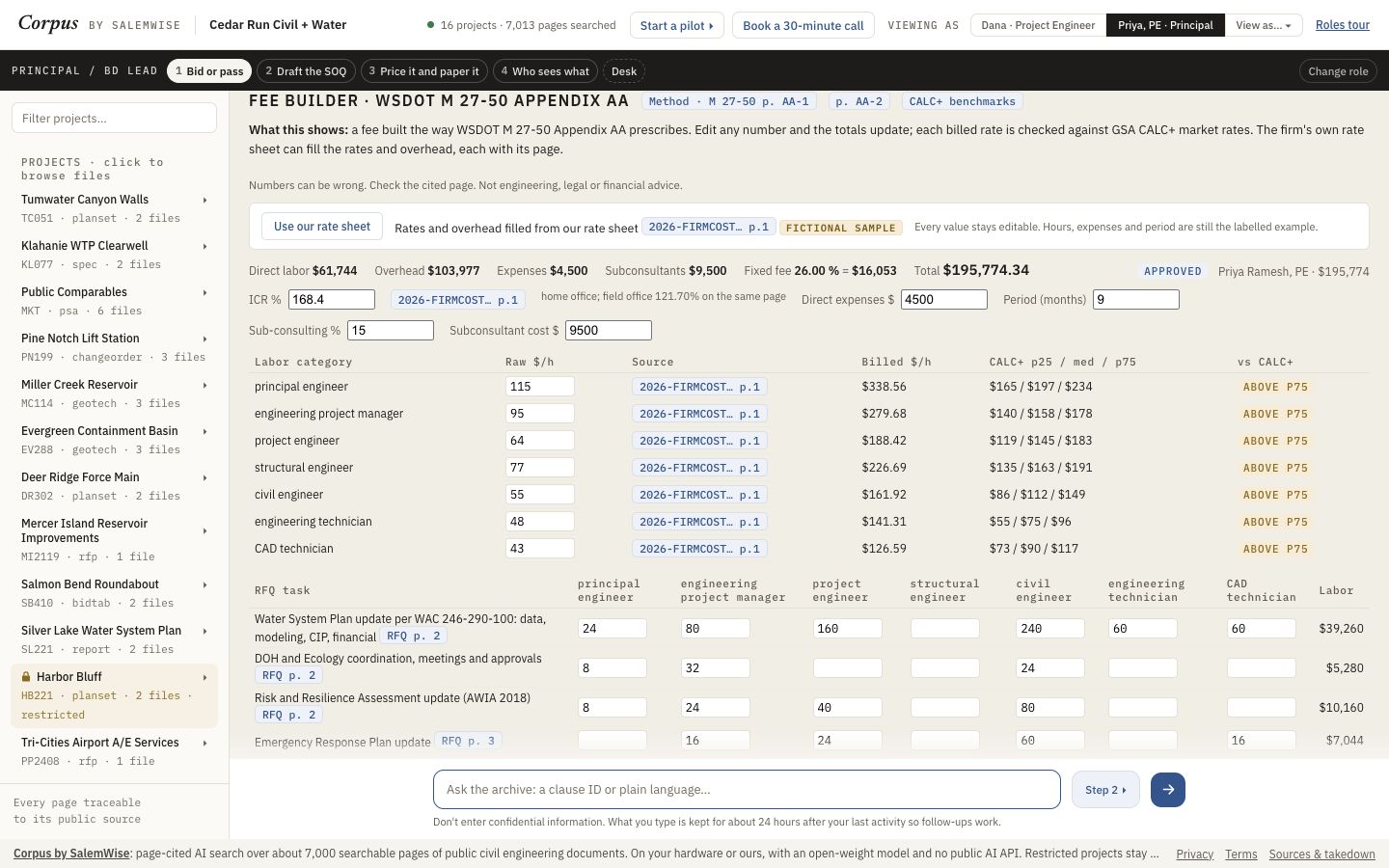
Open demo.salemwise.com/?path=principal in a browser on a laptop. The steps below are the ones we took on 2026-10-10, viewing as Priya Ramesh, PE (Principal).
- Open the principal path and click Fee under the RFQ line.
- The fee opens with labelled example inputs. Totals sit at the top: direct labor, overhead, expenses, subconsultants, fixed fee and total.
- Click Use our rate sheet. The seven raw rates and the overhead rate fill from the firm's rate file, each with its page. In our run the total became $195,774.34.
- Edit hours, expenses or the period and the totals update. Check the vs CALC+ column: in our run every rate showed ABOVE P75.
- Review the Appendix AA factors. Size of job, period and sub-consulting weights are computed; risk, difficulty and State assistance are judgement weights from 0.17 to 0.35.
- Click Approve fee. It shows APPROVED with Priya's name and the amount. Change any number and the approval clears.
Demo data is fictional: the firm, Cedar Run Civil + Water, its people, and every record marked Fictional sample are made up. The rest of the archive is real public engineering documents, filed under the fictional firm's project names, and the RFQs are real public RFQs.
What a person still checks
- Arithmetic done in code is only as good as its inputs and formulas, so a qualified person still checks them.
- The judgement weights, the overhead rate (the rate file also lists a field-office rate on the same page) and any rate flagged above the 75th percentile.
- The demo rates and hours are a fictional sample.
Try it on your own documents
Start with a free 30-minute call. Then run the $5,000 pilot on one real project or pursuit, credited toward setup if you sign a deployment within 60 days of the pilot's end.