

Research and go/no-go on a new RFQ
Corpus researches a new RFQ from your past projects, then suggests scores for 6 of the 9 go/no-go criteria. Fit, relationship and capacity are your call.
What it does
Six research cards answer one question each: RFQ intake, similar projects, cost history, comparable public fees, delivery risk and standards in play. Each finding is cited; a card with nothing citable says Nothing on file. The scorecard suggests a score with a reason for the 6 criteria the archive can speak to.
Who uses it
Principals and business development leads deciding whether to pursue an RFQ.
Step by step in the demo
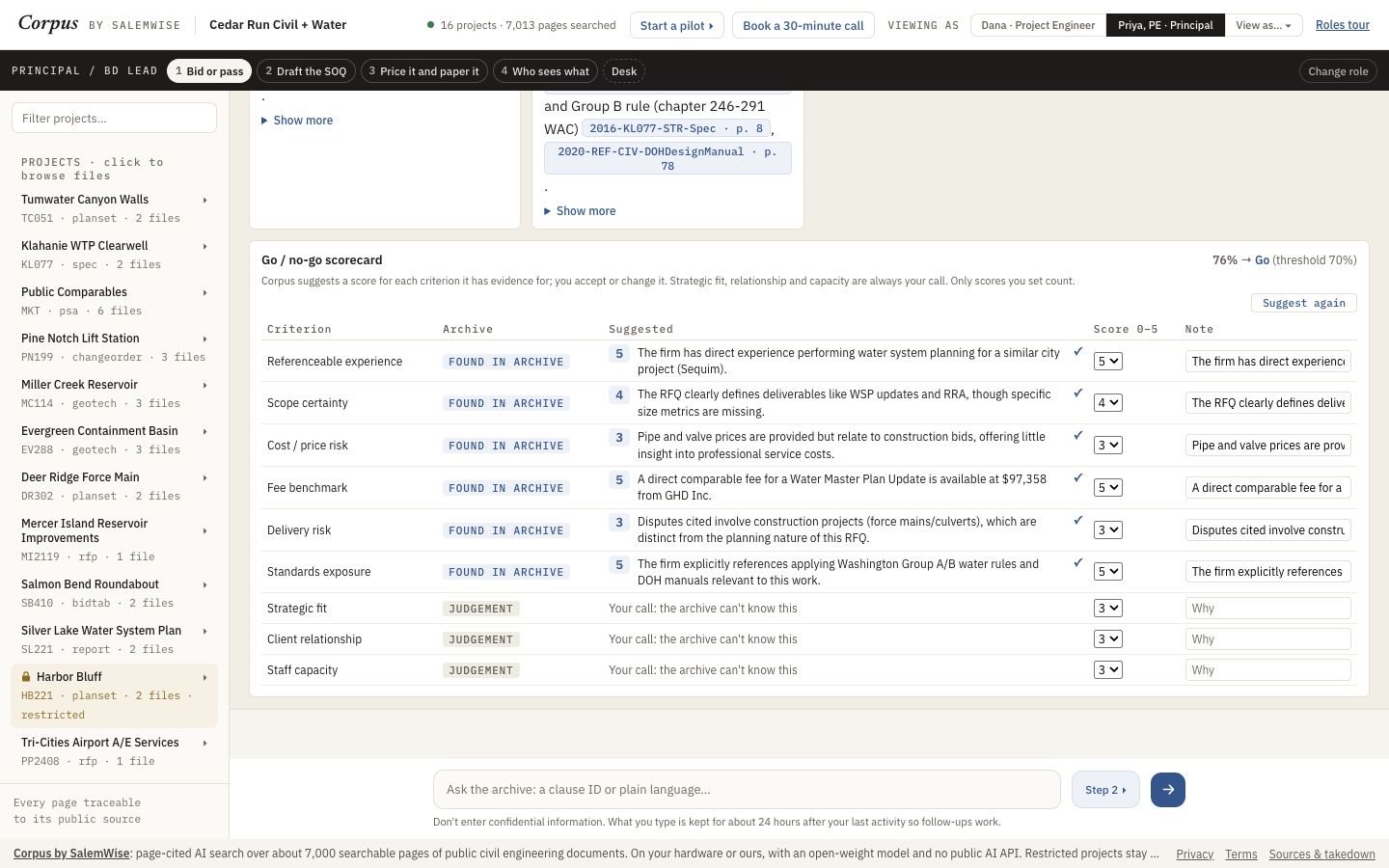
Open demo.salemwise.com/?path=principal in a browser on a laptop. The steps below are the ones we took on 2026-10-10, viewing as Priya Ramesh, PE (Principal).
- Open the principal path. It opens as Priya Ramesh, PE on step 1, Bid or pass.
- Check the RFQ line under the picker. Our run opened on City of Mercer Island RFQ 25-01, a Water System Plan update.
- Read the six research cards. Click Show more for the full finding and a page chip to open its source.
- Scroll to Go / no-go scorecard. Six criteria show a suggested score and a one-line reason, and the Score column starts at that number. Change any score you disagree with and add a note.
- Score Strategic fit, Client relationship and Staff capacity yourself, from 0 to 5.
- Read the verdict at the top right of the scorecard. With 3 on each judgement call, our run showed 76% and Go (threshold 70%).
Demo data is fictional: the firm, Cedar Run Civil + Water, its people, and every record marked Fictional sample are made up. The rest of the archive is real public engineering documents, filed under the fictional firm's project names, and the RFQs are real public RFQs.
What a person still checks
- The three judgement calls: the archive cannot know fit, relationship or capacity.
- Each suggested score, against the page it cites.
- Findings can be wrong. The demo labels them as not engineering, legal or financial advice.
Try it on your own documents
Start with a free 30-minute call. Then run the $5,000 pilot on one real project or pursuit, credited toward setup if you sign a deployment within 60 days of the pilot's end.