
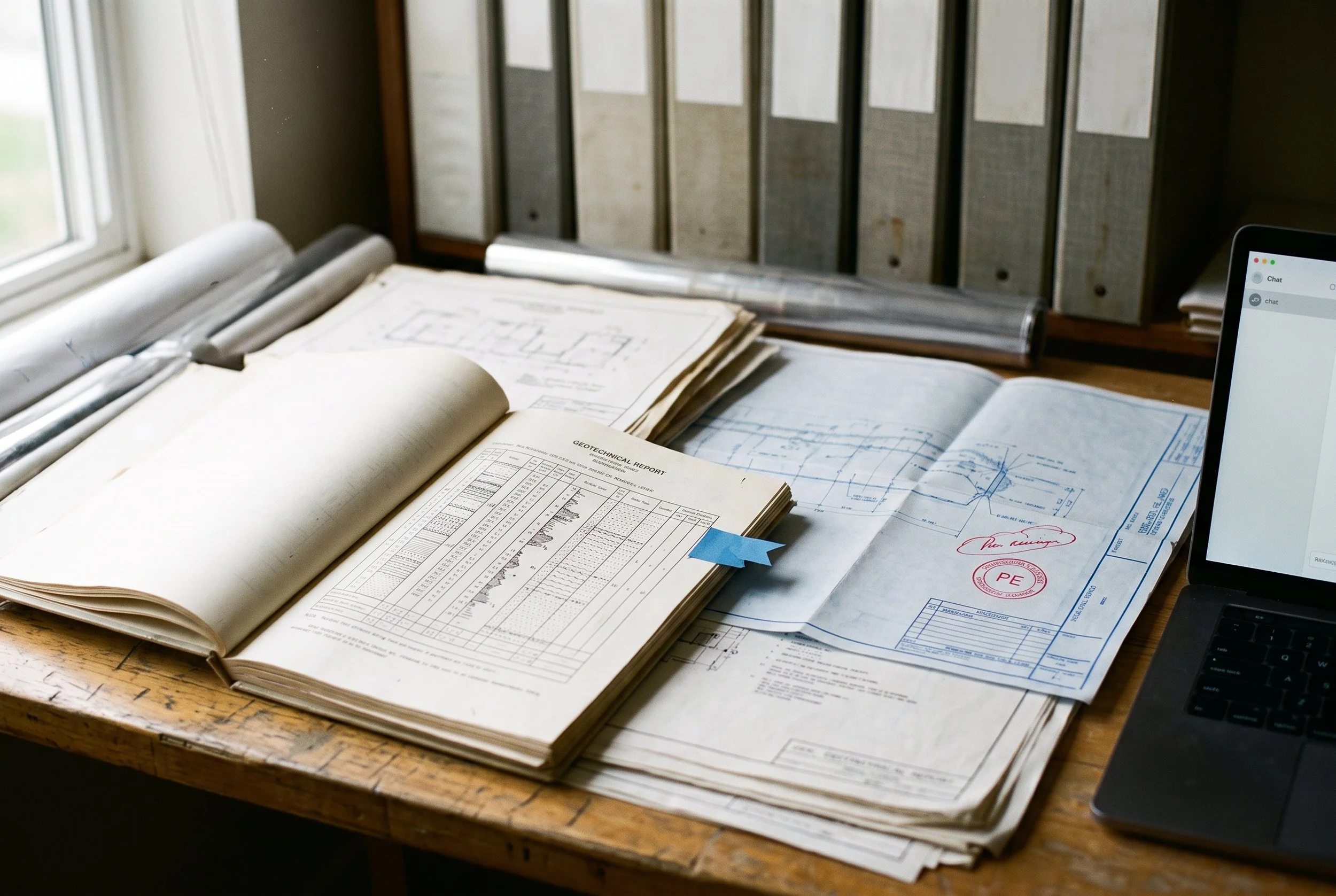
AI search for architecture and construction specs, submittals and RFIs
Corpus is AI search over your specifications, submittals, RFIs and past project files. Ask in plain words and get a short answer cited to the document and page, or “Nothing on file” when nothing supports one. It is the closest fit to our engineering work, and the live demo shows it on engineering documents.
The answer is on file. Finding it is the work.
The answer to an RFI is often in a spec section, an approved submittal or an RFI from the last job. Finding it means opening PDFs one by one.
- “What did the spec require for the vapor retarder under the slab?”
- “Did we approve a substitution for this storefront system on the last project?”
- “How did we answer a similar RFI on the school job?”
- Specs, submittals, RFIs, change orders and closeout files pile up on every project.
Answers from your own files, cited to the page.
- We load a copy of your specifications, approved submittals, RFIs and responses, change orders and past project files, saved as PDF. Corpus is retrieval-augmented generation (RAG): it answers from those files.
- Current You ask in plain words. Corpus searches by exact words and by meaning, then writes a short answer with citations to the document and page. Open a citation and the page opens with the passage highlighted, so you can check it.
- Current If nothing on file supports an answer, it is designed to say “Nothing on file” instead of guessing. An empty result does not prove that no such record exists.
- Current Access by role: files a role cannot open are removed before search runs, so answers never draw on them. In the demo, roles are illustrative and anyone can switch them. Set up for you Tying roles to your named people is part of full-deployment setup.
- Current Version history for drafts: each saved version shows who saved it, Compare shows what changed, and you can restore an earlier one. In the demo this covers fee, SOQ and contract drafts.
- Corpus reads PDF files, including scanned pages read by OCR. Set up for you OCR of your own scans is planned on the call and done during setup.
- Set up for you Corpus is cloud-agnostic: it runs on AWS, Azure, Google Cloud, or your own servers. It uses an open-weight model and no public AI API.
Example questions, not results
These questions are examples written for this page. They are not results: Corpus has no customers in this industry yet, and the live demo is built on engineering documents.
- What does the slab section of our spec require for the vapor retarder?
- Which past projects used this curtain wall system, and what did the approved submittal say about anchors?
- How did we answer RFIs about fire-rated joints on past projects?
- What warranty period does the roofing spec require?
Corpus finds and cites. People decide.
- The architect or engineer of record reads the cited page before answering an RFI.
- Whether the cited spec or submittal is the current revision. Corpus does not label revisions today.
- Code compliance and design decisions, which stay with your licensed professionals.
- Quantities and prices carried into a bid or a change order.
Corpus does not check code compliance or design. It finds and cites; licensed professionals decide.
Start with a free call. Then one real project.
- A free 30-minute call first. We talk about your files and the questions you need answered.
- Then a $5,000 pilot on one real project or pursuit, at a fixed price.
- We work from a copy of that project’s PDFs. Your originals are not touched.
- You ask your own questions, open the citations and judge the answers yourself.
- The $5,000 is credited toward setup if you sign a deployment within 60 days of the pilot's end.
- Our commitment In the pilot, your files are never used to train or fine-tune a model. In full deployment, fine-tuning on your files happens only if you agree in writing.
- Our commitment When the pilot ends, we delete the copy within 7 days and confirm it in writing.
See how citations and refusals work.
The live demo is built for engineering firms: public engineering documents filed under fictional sample firms. Its search also reaches a public-domain collection of U.S. court opinions. There is no demo built on another industry’s files. It shows what works the same in any industry: page citations, “Nothing on file” and roles.
→ Corpus by industryFrequently asked questions
Can Corpus read our drawings and BIM models?
Corpus reads PDF files, including scanned pages read by OCR. It does not read native CAD or BIM model files.
We already have project management software. Why add Corpus?
Keep it. Corpus answers questions across the PDFs those projects produced, with page citations. It does not manage RFIs or submittals.
Can it help with proposals for new work?
For engineering firms, Corpus drafts SOQ sections from past projects with page citations to check, and the live demo shows it. Whether that fits your proposals is what a pilot on one real pursuit tests.
Do you have customers in this industry?
Not yet. Corpus has no customers in this industry. Engineering firms are our first, worked-out example, and the live demo uses fictional engineering firms.
Where do our files go?
Set up for you Corpus is cloud-agnostic. It runs on AWS, Azure, Google Cloud, or your own servers. It uses an open-weight model, and nothing goes to a public AI API. In the pilot, your files are never used to train or fine-tune a model. In full deployment, fine-tuning on your files happens only if you agree in writing. We don't have a SOC 2 report, which is one reason you can choose your own servers.
Have a folder full of questions?
Book a free 30-minute call. We talk about your files, the questions you need answered, and whether a pilot makes sense.