
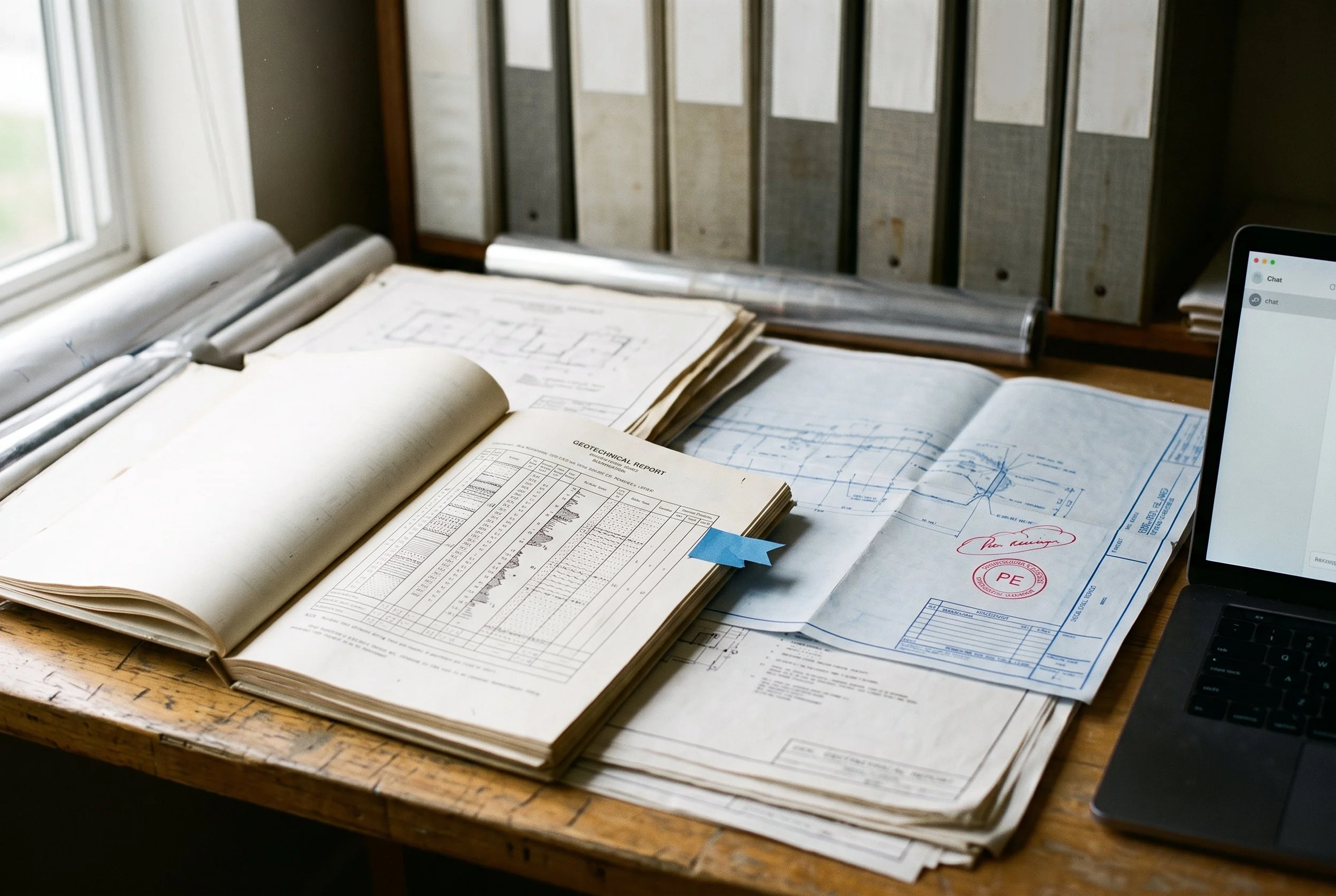
Human review you can see: from source to release
Corpus finds and drafts; people decide. It helps your team gather working material with citations to open. Your qualified people then check the sources that govern the work, the numbers and the assumptions behind them, settle what is missing or disputed, and approve the exact version a project decision rests on.
This is a suggested way to organize review, not a required procedure. Who checks what depends on your project, your client and your jurisdiction. Anything marked Proposed is not a product feature until it is built and shown in the demo.
Not yet reviewed by a licensed engineer. SalemWise wrote this page as a starting point for your own quality plan; check it against your firm’s or agency’s procedures before you rely on it.
Each “Corpus today” line carries its status.
- Current
- Works in the product and the public demo today; not independently certified.
- Set up for you
- Set up for your archive during setup; not shown in the demo; not yet done for any customer.
- Proposed: not built yet
- Not built. We discuss it on the free 30-minute call; scope and price are agreed in writing as paid work.
- Our commitment
- A promise about how we handle your work, written into the pilot or deployment agreement. Not a product feature.
- Not offered
- Not part of Corpus.
From source to release: what your people do, and what Corpus does today.
| Step | Your people | Corpus today |
|---|---|---|
| 1. Set the basis | Before anyone relies on the work, your reviewer confirms what governs it: the project, the jurisdiction and permit, which edition of each code or standard applies, the owner’s criteria, which documents take precedence, and what the result will be used for. An approach from a past project is not reused until someone confirms it still applies here. |
|
| 2. Prepare the draft | Whoever prepares the draft keeps, for each source used: its title or identifier, revision, date and approval status, the page or sheet, the passage relied on, where the original is kept, and any doubt about how the text was read from the file. |
|
| 3. Check the work | A qualified checker tests what the draft claims, where sources conflict, the calculations, and how the work fits with other disciplines. Your quality plan sets how independent that checker is and how deep the check goes. |
|
| 4. Settle exceptions | Every problem is written down: missing evidence, a disputed requirement, a check that failed. Each one gets a named owner and a decision. Missing evidence stays visibly missing until a person resolves it; it is never quietly filled in with a guess the software made. |
|
| 5. Approve for release | The person assigned to approve accepts one specific version for one stated use. Signatures and seals follow the rules of the project and the jurisdiction, and they come from your licensed people, never from software. |
|
| 6. Keep the record and recheck | Keep the review evidence with the approved record. When a source, method, model or requirement changes, reopen the checks that depend on it. |
|
Suggested practices for calculations.
| Practice | Suggested practice | Corpus today |
|---|---|---|
| 1. Inputs and units | Record where each input came from: the source and its revision, the value as read, its units and datum, the date, and how certain it is. Compare numbers, exponents and symbols read from a scan with the page image. |
|
| 2. Method and scope | Confirm the method before trusting the numbers: the approved formula or model and its version, the assumptions, the boundary conditions and the limits of use. Flawless arithmetic on the wrong case still gives a wrong result. |
|
| 3. Reproduction | Reproduce the result with an approved independent check or an established tool, then compare the results, the ranges and how sensitive they are to the inputs. |
|
| 4. Requirement checks | Relate the result to the criteria and the edition that govern this project. A familiar acronym or a similar past project does not show that a requirement applies. |
|
| 5. Review record | Keep a record of the review: who prepared the work, who checked it, what they found, what was corrected, which version was accepted, and enough of the basis for someone else to reproduce it. |
|
What Corpus and SalemWise do not do.
- Not offered Corpus finds documents and prepares drafts. It does not run plants, control processes, act on safety systems or approve permits; connecting it to operational technology would need its own scope, authority and evaluation.
- Not offered Corpus does not check code compliance or certify designs.
- Not offered SalemWise does not provide licensed engineering services.
- The place Corpus runs does not, by itself, meet a rule, standard or contract.
The goal is work that draws on records you are cleared to use, meets the requirements that apply to the job, and is approved by the people who answer for the decision.
Bring your quality plan to a free 30-minute call. Engineering firms can then try Corpus on one real pursuit in the pilot.